
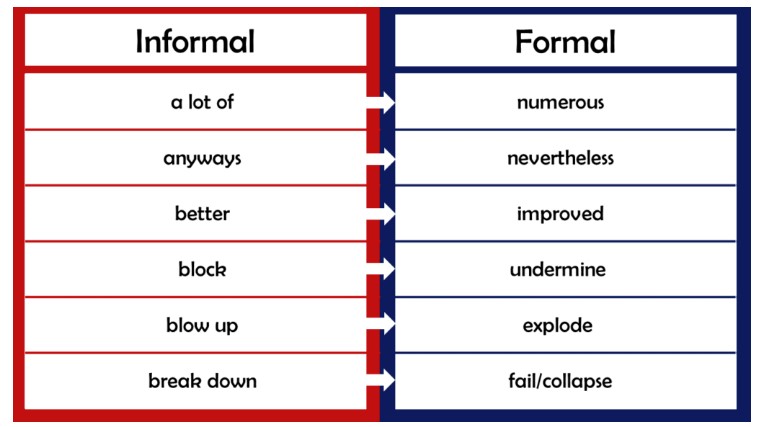
A Formal Words List is essential for anyone who wants to improve their professional and academic communication. Using formal words instead of casual phrases not only conveys intelligence but also ensures clarity, respect, and sophistication in your writing. Whether you are crafting emails, reports, essays, or presentations, mastering formal vocabulary is crucial for leaving a strong impression.
In everyday conversation, we often use casual expressions like “a lot of,” “kind of,” or “get.” While these are acceptable in informal settings, they can undermine your credibility in professional or academic contexts. A Formal Words List equips you with precise alternatives that convey the same meaning with professionalism.
Why Using Formal Words Matters
Incorporating a Formal Words List in your writing demonstrates authority, attention to detail, and strong command over language. It signals to the reader that you respect their time and are serious about the subject matter.
For example, saying “She is really smart” is informal and vague. Replacing it with “She is exceptionally insightful” instantly elevates the tone and conveys specificity. Similarly, swapping “get” with words like “obtain” or “acquire” adds clarity and professionalism.
Categories of Formal Words
A robust Formal Words List covers multiple categories to address various writing needs:
Verbs: acquire, implement, facilitate, ensure
Adjectives: exceptional, significant, remarkable, comprehensive
Adverbs: effectively, precisely, consequently, notably
Nouns: correspondence, assistance, requirement, evaluation
Using words from these categories enables you to express ideas with precision and sophistication, avoiding overused casual phrases.
Common Casual Phrases and Formal Alternatives
One of the most effective ways to improve writing is by identifying casual phrases and replacing them with formal equivalents from a Formal Words List.
-
“A lot of” → numerous, several, a significant number of
-
“Kind of” → somewhat, relatively, moderately
-
“Get” → obtain, acquire, receive
-
“Help” → assist, facilitate, support
-
“Show” → demonstrate, illustrate, indicate
By making these substitutions, your writing gains clarity, credibility, and polish.
Using Formal Words in Professional Emails
Emails are a primary mode of professional communication, and a Formal Words List is invaluable for crafting effective messages.
Instead of writing, “I want to ask about the project,” you can write, “I would like to inquire regarding the project.” This small adjustment changes the tone from casual to professional. Similarly, replacing “I need your help” with “I would appreciate your assistance” conveys respect and professionalism.
Academic Writing and Formal Vocabulary
Academic essays and research papers demand formal language. A Formal Words List ensures that your work maintains an appropriate tone and avoids casual expressions that can undermine credibility.
For instance: “The study shows a lot of problems” → “The study highlights numerous challenges”
“People kind of think that” → “Individuals generally perceive that”
These subtle changes make your writing more polished, authoritative, and compelling.
Storytelling and Example Usage
Even in storytelling or narratives, formal vocabulary enhances readability and professionalism. Consider the difference between:
-
Casual: “She got really angry when she saw the mess.”
-
Formal: “She became exceedingly frustrated upon observing the disarray.”
The second sentence uses a Formal Words List to replace casual expressions with precise, descriptive language, creating a stronger impact on the reader.
Adapting Spoken Language
A Formal Words List isn’t just for writing—it can improve spoken communication as well. In presentations, meetings, or interviews, using formal alternatives signals confidence and competence.
Instead of saying, “I’ll try to do this,” say, “I will endeavor to accomplish this.”
Instead of, “We got some results,” say, “We obtained several noteworthy results.”
These adjustments elevate your tone and make your statements more persuasive.
Techniques to Incorporate a Formal Words List
-
Identify Casual Words: Review your writing or speech for casual phrases.
-
Use a Formal Words List: Replace casual expressions with formal alternatives.
-
Practice in Context: Integrate new words in sentences to understand nuance.
-
Review and Refine: Continuously update your list with new formal vocabulary.
Regular practice ensures that formal words become second nature, enhancing both your writing and speaking.
Common Pitfalls to Avoid
While using a Formal Words List is highly beneficial, overuse can make your writing sound stiff or unnatural. Balance formal and natural language to maintain readability. Always prioritize clarity over complexity; the goal is effective communication, not impressing the reader with obscure words.
Long-Term Benefits of Formal Vocabulary
Mastering a Formal Words List offers numerous benefits:
-
Improved academic performance through polished essays and assignments
-
Enhanced professional communication in emails, reports, and presentations
-
Greater credibility in interviews and public speaking
-
Stronger persuasive writing for proposals, marketing, and publications
By investing time in learning and applying formal vocabulary, you cultivate a skill that benefits every area of communication.
Practical Examples in Daily Writing
-
Casual: “I need to get some information.” → Formal: “I need to obtain pertinent information.”
-
Casual: “The project went really well.” → Formal: “The project proceeded successfully and yielded significant outcomes.”
-
Casual: “Can you help me with this?” → Formal: “Could you kindly assist me with this task?”
These examples illustrate how a Formal Words List can transform ordinary writing into professional, polished communication.
Read also:
cacophony meaning
pluviophile
success synonyms
support synonym